UPC WAZE's Rule 28: One of the Ways to Direct UPC Case Traffic Jam ?
Article
Patent Law
| 31/03/26 | 9 min. |
Lionel Martin
Océane Millon de La Verteville
Nearly three years after the Unified Patent Court opened its doors, the UPC first-instance court docket has developed a pronounced traffic jam in the German Local Divisions which together absorb a commanding share of infringement cases, while other Local Divisions across Europe sit with ample capacity. German dominance in the UPC is currently the subject of very intense debate within the European patent community, following the consultation launched by the UPC Advisory Committee with EPLAW, BusinessEurope, EPI, and EPLIT[1]. The presiding judge of the Mannheim local division himself publicly called for rebalancing[2]. Several observers have raised concerns that this overwork on the part of German regional courts could prevent them from meeting the speed contemplated in the Rules of Procedure —a risk that has, in some cases, already materialized.
Tyring to propose a part of the possible solution to maintain UPC speed as well as contributing to the pending brainstorming encouraged by the UPC observer associations, there is a possible publicly adverstised use of the Rule 28 as a possible traffic light to help regulate the claimant’s choice of forum towards a more evenly speedy UPC.
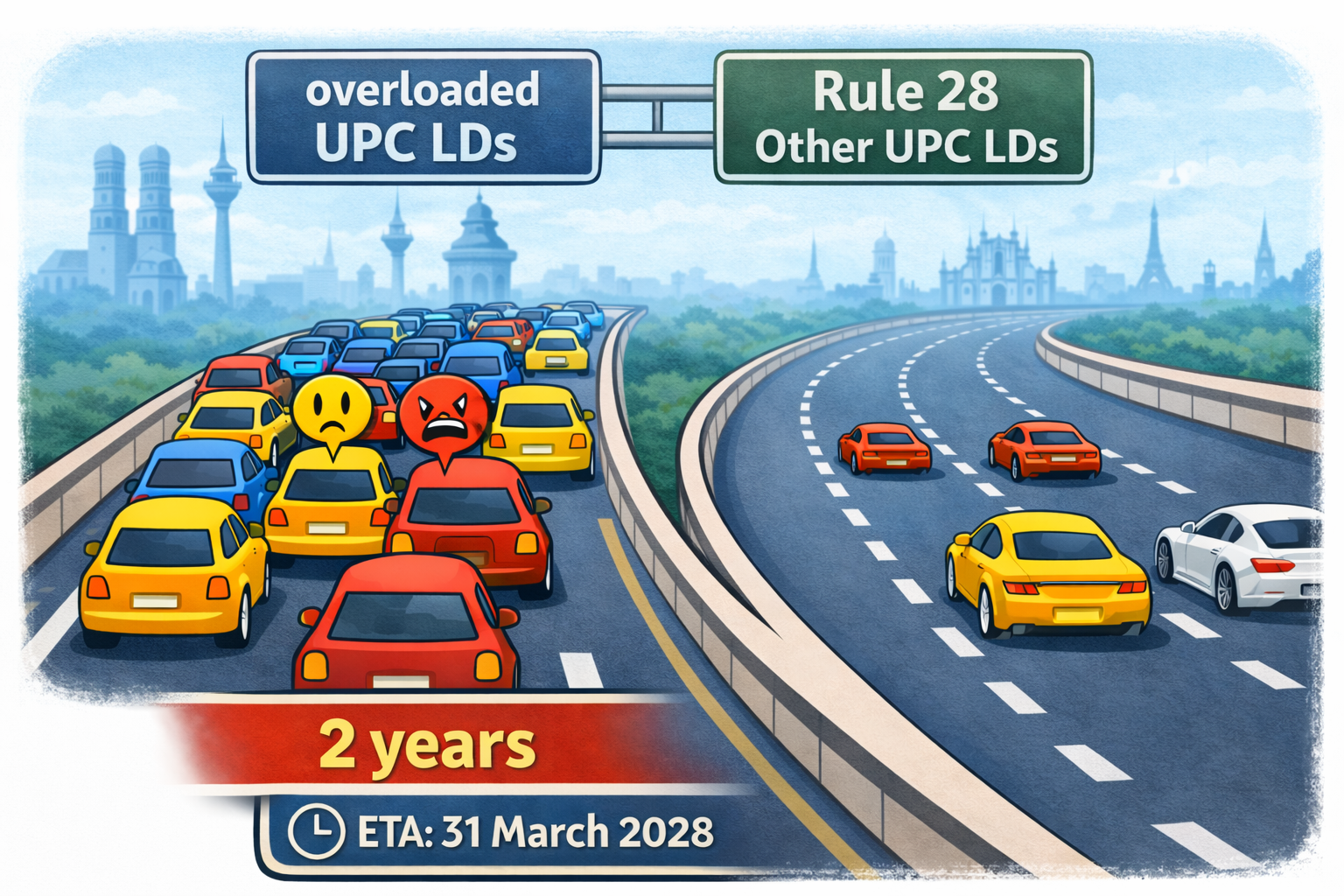
The Congestion Problem
The numbers tell a familiar story. Sophisticated claimants, including Standard Essential Patent owners, not to mention UK-headquartered patent litigation teams that lost their natural London forum after Brexit, have gravitated towards divisions perceived to offer the fastest, most predictable proceedings. The self-reinforcing dynamic is well-known to anyone who has sat in traffic: the more cases a division attracts, the more its "track record" reassures future filers (as the well-known saying goes, “You can't get fired for choosing IBM.”), and the more new cases pile in.
But speed is a promise, not a constant. The Preamble to the UPC Rules of Procedure sets an ambitious benchmark: final oral hearings at first instance should normally take place within one year of filing, with written decisions to follow within six weeks of the oral hearing pursuant to Rule 118. When a division's docket swells beyond what its panels can absorb, those targets slip — and the very efficiency that attracted claimants in the first place begins to erode. Commentators, including Prof. Willem Hoyng, chair of the UPC Advisory Board, have already flagged instances — including one with a potential two-year time between filing and final hearing — where busy divisions appear to compress or effectively skip the interim procedure, raising concerns about the quality and thoroughness of case preparation[3].
Rule 28 as a Navigation Signal
This is where Rule 28 enters the picture. Under its terms, "as soon as practicable after service of the Statement of defence, the judge-rapporteur shall, after consulting the parties, set a date and time for an interim conference (where necessary) and set a date for the oral hearing."[4] In other words, Rule 28 already requires the judge-rapporteur to calendar the decisive stages of each case at a relatively early point in the proceedings, i.e. approximately 4 months after the filing of an infringement claims.
The proposal is disarmingly simple: make those Rule 28 scheduling notifications public and systematic. If every division were required to publish, at or shortly after the filing of the Statement of Defence, the estimated date for the final oral hearing and the projected date for the written decision on the merits, litigants would, for the first time, have quasi real-time visibility into division-level congestion. A claimant considering Munich or Düsseldorf might discover that the earliest available hearing slot is sixteen or eighteen months out, while Paris, Milan, The Hague, or Helsinki could offer a hearing within the twelve-month target. The almost 4-month between the filing an infringement claim and the Rule 28 notification can even be compensated with estimate time algorithm just as Waze recalculates your route when it detects a traffic jam ahead. In other words, a transparent Rule 28 calendar would allow rational actors to recalculate their forum choice.
Why Transparency Alone Could Move the Needle
Patent litigators consistently report that, once confidence in judicial quality is established, time-to-decision is the single most important variable driving forum selection. A scholarly study on inter-court competition in Germany before the UPC's entry into force confirms this dynamic: courts that signalled pace attracted cases, and courts that fell behind lost them[5]. The same competitive logic should work within the UPC system — but only if the information is visible.
Today, claimants choosing between divisions are navigating largely in the dark. Backward-looking statistics on decided cases exist but tell an incomplete story, not least because a significant number of matters in busy German divisions settle after the oral hearing — often prompted by a preliminary judicial assessment delivered at the outset of the hearing — and never produce a published judgment. Settlements depress observable win-rate differentials and mask true docket pressure. A forward-looking, case-specific Rule 28 estimate would cut through this opacity.
A Measure That Can Be Taken Now
We believe that the beauty of the Rule 28 transparency proposal is that it requires no treaty amendment, no revision of the Rules of Procedure, and no politically fraught rebalancing of judicial appointments. The rule already exists; the judge-rapporteur already sets the dates. All that is needed is a mere administrative decision directing that those dates be published and easily accessible on the UPC's public register as a matter of course. Of course UPC users would appreciate, on the top of that, access to the average time taken to make a decision in infringement cases, broken down by local division.
Rule 28 transparency is a low-friction, high-information intervention that respects claimant choice while ensuring that choice is an informed one.
Beyond Waze: Part of a Broader Toolkit
Of course, Rule 28 transparency will not be a silver bullet. Of course, other mechanisms could be considered to address the issue of overburdened German divisions, and that is precisely the focus of the ongoing public consultation. For example, EPLAW asked its members for their opinions on the following measures : offering parties a transfer to another division if it appears likely that the case would not be decided within a given timeline, or allowing the UPC (e.g., the President of the Court of First Instance) to mandatorily distribute new cases or redistribute existing cases based on caseload. However, their implementation would certainly take time.
The Waze analogy is an apt example of an immediate, implementable first step. Traffic jams do not resolve when every driver follows the same route. They ease when drivers can see in real time where the congestion is and where the road is clear. Rule 28 already generates this data. All the UPC needs to do is turn the screen on.
[3] See Prof. Willem Hoyng's comments on the HRM website regarding the following decisions: LD Mannheim, 19 Dec. 2025 in UPC_CFI_134/2024 ; LD Mannheim, 13 jan. 2026 in UPC_CFI_850/2024 ; LD Munich, 13 Jan. 2026 in UPC_CFI_628/2024 and UPC_CFI_125/2025 ; LD Dusseldorf, 11 Feb. 2026 in UPC_CFI_351/2024; UPC_CFI_595/2024 which took 17 months to be decided ; LD Dusseldorf, 11 Feb. 2026 in UPC_CFI_336/2024; UPC_CFI_605/2024; UPC_CFI_607/2024 in which oral argument took 18 months. See also F. Mueller comments regarding the Dolby and SPT cases against Roku in its article dated 29 Aug. 2025 on the IPFray website.

 back
back